
What personalisation methods are available for engraved wedding rings?
Personalisation methods for engraved wedding rings include names, initials, dates, meaningful messages, handwritten notes, fingerprints, symbols and bespoke motifs. Depending on the ring’s metal, width and finish, these details can be applied by hand or machine to the inside or outside of the band, with your design refined to suit the available engraving area.
Personalisation for an engraved wedding ring can include names, initials, dates, meaningful wording, handwritten messages, fingerprints, symbols and bespoke motifs. These details may be engraved by hand, machine or laser, depending on the ring’s metal, width, profile, finish and the level of detail required. Engraving can usually be placed on the inside or outside of the band, subject to the available surface and the structure of the ring.
Text engraving is the most established option. You might choose both partners’ names, initials, a wedding date, a proposal date, a location, a short quotation or a phrase with personal significance. Text can be presented in a traditional serif style, a clean modern typeface or a script style. The wording should be kept concise enough to remain legible, particularly on a narrow band or a curved inner surface.
Dates and initials offer a discreet form of personalisation when you want the ring to remain visually simple. A date can be written numerically or in words, while initials can be separated by a symbol or joined with a small motif. It is worth checking spelling, punctuation and date formatting carefully before approval, as the engraving is permanent and corrections may require the affected area to be polished or reworked.
Handwriting engraving reproduces a sample of writing supplied by you. This could be a signature, a short handwritten message or a few words written specifically for the ring. The original sample is converted into a design suitable for engraving, with very fine strokes adjusted where necessary so they do not disappear on the metal. Handwriting is particularly effective for a short message, as longer notes may need to be reduced and can lose clarity.
Fingerprint engraving uses a supplied fingerprint to create a personal pattern, usually on the inside of the ring. It may be engraved as a partial impression or as a simplified design that fits the available area. Fingerprint detail varies naturally, and the result is influenced by the quality of the original impression, the ring’s size and the engraving depth. A clear source image or impression is therefore important.
Symbols and motifs provide an alternative to words. Suitable designs may include a heart, infinity symbol, star, flower, constellation, paw print, geographical outline or a motif connected with a shared interest. A bespoke symbol can also be created from a sketch or reference image. Simple, well-defined artwork generally produces the clearest result; highly intricate designs may need to be simplified to suit the scale of the ring.
Other possible approaches include a soundwave pattern made from a recorded word or phrase, a meaningful date represented in a chosen format, or a small illustration based on a personal design. These options need careful preparation because a pattern that looks clear on a screen may become difficult to read when reduced to the width of a ring. The design should be assessed at its intended size before engraving.
Hand engraving is cut directly into the metal by an experienced engraver using specialist tools. It is valued for its individual character, including subtle variations in line and depth. It is well suited to decorative lettering, flowing script and traditional motifs, although the available styles depend on the engraver and the ring’s construction.
Machine engraving uses a guided cutter to reproduce lettering and straightforward designs consistently. It can provide precise, even results and a broad choice of typefaces. Machine engraving is often appropriate for names, dates and standard symbols, particularly where uniformity and legibility are the priorities.
Laser engraving uses a focused beam to mark the surface with fine detail. It can reproduce small artwork, handwriting, fingerprints and complex digital designs with a high degree of precision. The appearance depends on the metal and finish: the mark may appear darker, frosted or subtly contrasting rather than deeply cut. Laser engraving is not automatically suitable for every ring, so the surface and construction should be assessed first.
Personalisation can also be combined with the ring’s finish. A polished surface usually gives strong contrast and clear definition, while a matt, brushed or textured finish can create a more understated result. Some designs use a polished engraved area within a matt band, or a contrasting finish to make the lettering easier to see. The chosen treatment must be compatible with the metal and should not compromise any existing detailing.
Before the design is finalised, consider:
- whether the engraving will be inside the band, outside the band or across both surfaces;
- the amount of space available after allowing for a comfort fit, pattern, stones or other details;
- the lettering style and minimum size needed for the wording to remain readable;
- how the proposed design will look on the ring’s curvature rather than on a flat screen;
- whether the ring may need resizing or substantial polishing in the future; and
- whether the selected metal and finish are suitable for the chosen engraving method.
Engraving is a permanent alteration, but it does not have to be limited to conventional wording. A combination of a date, initials and a small symbol can create a restrained design, while handwriting, fingerprints or a bespoke motif can provide a more distinctive result. The most suitable method is determined by the design you want to achieve and the practical characteristics of the ring, so the artwork should be reviewed with an experienced jeweller before work begins.
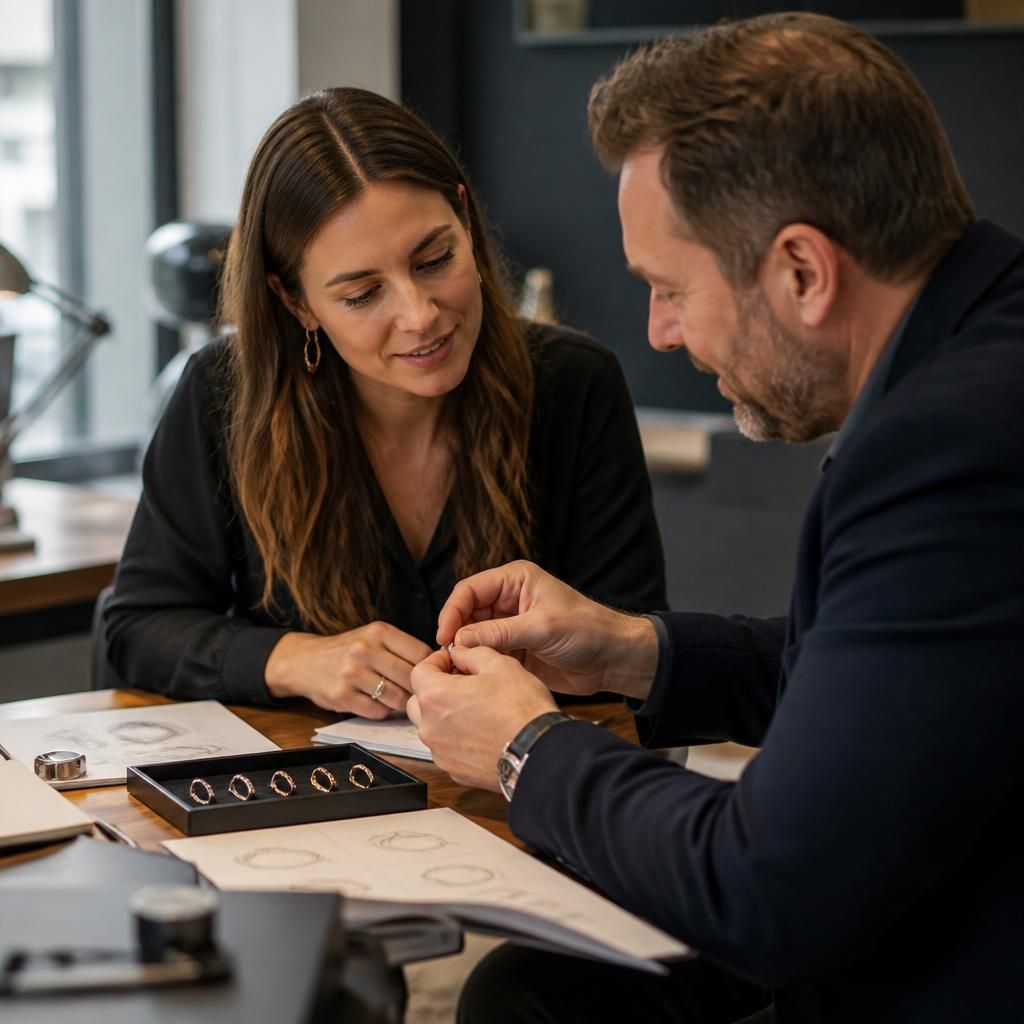
Personalisation for an engraved wedding ring should be chosen alongside the ring’s metal, width, profile and finish. These features determine which details can be reproduced clearly and whether the engraving is best placed inside or outside the band.
Short text, initials and dates are generally suitable for most rings, provided the lettering is sized to remain legible on the available surface. Handwriting, fingerprints and bespoke artwork require more careful preparation: fine lines may need simplifying before engraving, particularly on a narrow or highly curved band. A polished surface usually provides clearer definition, while a matt or brushed finish creates a more understated appearance.
Before approving the design, review it at the ring’s intended size rather than relying on a flat digital preview. Check the spelling, punctuation, date format and placement, and discuss any future resizing or substantial polishing with your jeweller. Engraving is permanent, so confirming the artwork and the ring’s practical limitations at this stage helps achieve a clear, durable result.
Discuss your engraved wedding ring personalisation options
Discuss your preferred wording, handwriting, fingerprint or bespoke motif with our jewellery team, who can advise on the most suitable engraving method and placement for your ring. We can review the design at its intended size before engraving begins.