
What are the limitations of engraving personalised rings in terms of design and space?
Personalised ring engraving is limited by the ring’s available surface area, profile, material and engraving method. Small or narrow bands may only accommodate short text or simple symbols, while detailed designs, long messages and some fonts may lose clarity or require a wider, flatter engraving area.
The main limitations of engraving a personalised ring are the amount of usable surface space, the ring’s shape and thickness, the engraving method, and the material being engraved. A narrow or highly curved band may only suit a short inscription or uncomplicated symbol, whereas a broad, relatively flat surface can accommodate more detailed lettering or artwork. The design must be planned to remain legible, structurally safe and appropriate for the ring’s finish.
Available space is usually the first consideration. The inside of a ring may have less room than expected because of a comfort-fit curve, a hallmarked area, a sizing join, or the setting beneath a stone. On the outside, shoulders, decorative edges, gemstones and textured finishes can interrupt the engraving area. A message that appears suitable when written on paper may need shortening once it is adapted to the available curve.
Long wording is therefore one of the most common restrictions. Names, dates, initials and brief phrases generally work well, but a lengthy quotation may require smaller lettering, multiple lines or a different location. Reducing the lettering too far can make fine strokes merge together and make the inscription difficult to read, particularly after polishing and normal wear. In many cases, a concise phrase will provide a clearer and more durable result than trying to fit every word into a limited space.
The ring’s profile also affects what can be engraved. A wide, flat band offers a more consistent surface for text and detailed motifs. A narrow band, domed band or heavily tapered design can distort lettering as it follows the curve. Engraving around the circumference presents a further challenge because the beginning and end of the inscription must be positioned carefully, and the text may be harder to read when viewed in sections. An inscription across the inside of a curved band may also need adjusted spacing so that it sits comfortably and appears balanced.
Detailed artwork has similar limitations. Intricate crests, handwriting, fingerprints and fine line drawings can be reproduced only when the ring provides enough room for the smallest details to remain distinct. Very fine lines may soften through wear or become less visible if the engraving is shallow. Bold, simplified versions of a design are often more successful than attempting to reproduce every small feature of an original image.
Font choice makes a practical difference. Clear, moderately weighted lettering is normally easier to read than an elaborate script, especially on a narrow band. Flourishes, closely spaced characters and very fine strokes can lose definition when reduced to fit. Handwritten text can be meaningful, but it may need to be cleaned up or simplified while retaining the character of the original writing. A proof or digital layout should be checked at the approximate finished size rather than judged only from a large screen image.
The engraving method can impose further design limits. Traditional hand engraving allows an experienced engraver to follow the shape of a ring and create expressive cuts, but the available result depends on the surface and the engraver’s technique. Machine engraving can produce consistent lettering and symbols, while laser engraving can reproduce fine artwork and certain handwriting styles. Each method has different capabilities in terms of depth, line weight, texture and contrast, so the most suitable option depends on the ring rather than on the design alone.
Material and finish must be considered before approval. Gold, platinum, silver and other jewellery metals respond differently to cutting, polishing and wear. A highly polished surface may show the contrast of an inscription clearly at first, while a brushed or textured surface may produce a subtler appearance. A finish can also be changed when the engraving is applied, particularly if the design extends across more than one surface. Existing rings should be assessed for their condition, previous resizing, thinning or damage before any metal is removed.
Gemstones and settings restrict where engraving can safely be placed. On a ring with stones around much of the circumference, there may be little uninterrupted metal. Engraving too close to a setting can affect the surrounding structure or complicate future repairs. On some designs, the only suitable location is a small section inside the band. The setting, claws and underside of the stones should not be treated as spare engraving space, as they have functional rather than decorative roles.
There can also be practical limits after the engraving has been completed:
- Future resizing: altering the circumference can stretch, compress or remove part of an inscription. The position and length of the engraving should be discussed before resizing, particularly where the wording runs around the band.
- Wear and maintenance: exposed engraving gradually loses sharpness through contact with skin, other jewellery, tools and everyday surfaces. Deeper or more robust lettering may last better, but excessive depth is not suitable for every ring.
- Ring thickness: a very thin band may not have enough metal for deep cuts or extensive detail. Removing too much material can weaken the ring, so structural safety takes priority over fitting a larger design.
- Surface continuity: grooves, milgrain, pavé settings, patterned metal and mixed finishes can interrupt letters or make a design appear uneven.
- Readability: text must have enough contrast, spacing and line definition to remain recognisable at the finished scale, not simply when viewed in a design proof.
When space is restricted, the design can often be adapted without losing its meaning. Options include using initials instead of full names, selecting a significant date or short phrase, combining a small symbol with brief text, or placing different parts of a message on separate areas of the ring. A meaningful mark, such as a simple motif or a carefully prepared section of handwriting, may be more effective than reducing a long inscription until it becomes unclear.
Before engraving, the ring should be examined in person and the proposed wording, font, placement, size, method and finish agreed in advance. It is important to check spelling, punctuation, character order and the orientation of the inscription, particularly for an inside engraving that will be viewed by turning the ring. If the ring is being made to order, engraving should be considered alongside the band width, profile, setting and any possible future resizing rather than added as an afterthought.
In practice, the best engraving is not necessarily the largest or most elaborate design. It is one that suits the metal and available surface, remains legible at its finished size, and leaves enough material for the ring to remain strong and comfortable. A careful assessment and a realistic proof will show whether the original idea can be engraved as supplied or whether it should be shortened, simplified or moved to a more suitable area.
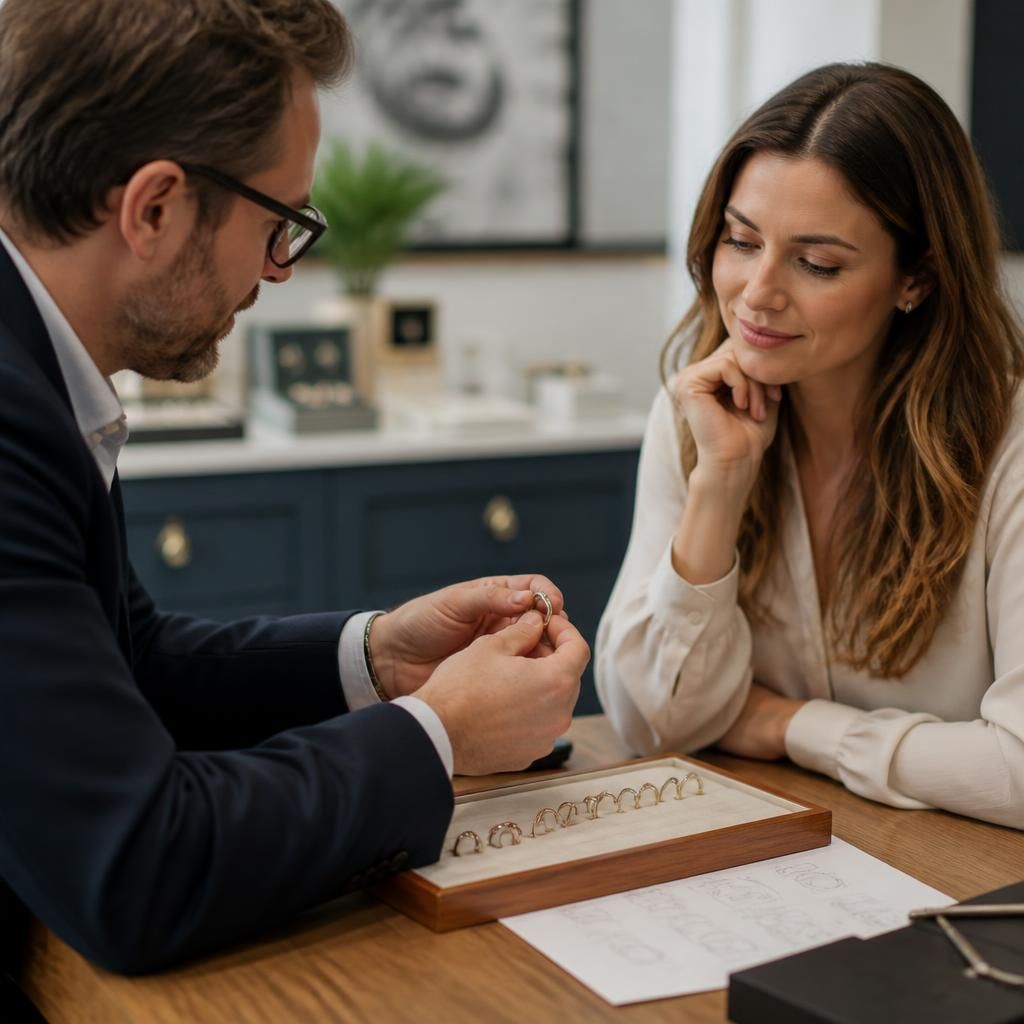
The available surface area is the main limitation when engraving a personalised ring. A narrow, curved or stone-set band may only allow a short inscription, initials or a simple symbol, while a wider, flatter band can accommodate longer wording or more detailed artwork.
Engraving must remain readable at its finished size. Fine scripts, closely spaced letters and intricate images can lose definition when reduced to fit, particularly on a small inner band. If space is limited, shortening a phrase, choosing a clearer font or simplifying a motif usually produces a more attractive and durable result than compressing too much detail into the design.