
What are the crucial details to verify when purchasing a pre-owned Rolex GMT Master II?
When purchasing a pre-owned Rolex GMT Master II, verify its authenticity, reference and serial details, originality, condition, service history, and the availability of its box and papers. A reputable inspection should also confirm the movement, bezel, bracelet, and water-resistance condition before you commit to the purchase.
Before purchasing a pre-owned Rolex GMT-Master II, verify its authenticity, exact reference and serial details, originality, condition, service history, provenance, and the presence of its box and papers. A proper inspection should also assess the movement, GMT function, bezel, bracelet, clasp, crystal and water resistance, so that you understand precisely what you are buying and whether any future work is likely to be needed.
Confirm the exact reference and configuration
The GMT-Master II has been produced in a wide range of references, metals, bezel colours, bracelet options and dial configurations. The reference should correspond with the watch’s visible specification. Check the case material, bezel, dial, hands, bracelet and clasp against the reference rather than relying solely on the seller’s description.
This is particularly important because a watch may have had components replaced during servicing, or may have been modified with non-original parts. A change can affect collectability, value and the availability of suitable replacement parts. The reference should also be compared with Rolex records or reliable specialist documentation where appropriate.
Check the serial number and supporting records
The serial number is an important identity marker, but it is not proof of authenticity by itself. It should be legible, consistent with the watch’s age and correctly presented on the case or rehaut, depending on the model and production period. The number should also match the warranty card or other accompanying documentation where those records are available.
Do not treat matching numbers as conclusive evidence that a watch is genuine. Counterfeit watches can carry copied or reused numbers, and paperwork can be separated from the watch it originally accompanied. The case number, movement, dial, bracelet and overall construction must all be assessed together.
Establish authenticity through a physical inspection
Authenticity should be verified by examining the watch as a complete object, not just its external markings. A competent inspection will consider:
- the quality and finishing of the case, crown, crown guards and case back;
- the typography, alignment and finishing of the dial and hands;
- the construction and colour of the Cerachrom or aluminium bezel insert, where applicable;
- the engraving and finishing of the rehaut on relevant models;
- the movement calibre, architecture, markings and quality of assembly;
- the operation of the winding system, date change and GMT hand; and
- the consistency between the watch’s parts and its stated reference.
A watchmaker or established specialist should carry out this examination. Photographs can help with an initial assessment, but they cannot reliably confirm the movement, water resistance or originality of internal components.
Assess originality and any modifications
Ask whether every significant component is original to the model. Pay close attention to the bezel insert, dial, hands, crystal, bracelet and clasp. Some replacement parts may be genuine Rolex components but not correct for that particular reference or production period. Others may be aftermarket parts, which can reduce desirability and complicate future servicing.
Customised watches require particular care. Gem-setting, refinishing, coloured coatings, replacement dials and non-standard bezels may change the watch’s appearance and value. They can also affect insurance, servicing and the possibility of returning the watch to its original specification. Any modification should be declared clearly and reflected in the price.
Evaluate the case and overall condition
Inspect the lugs, bezel, case edges, crown guards and case back for scratches, dents, corrosion and signs of excessive polishing. A lightly worn watch is not necessarily preferable to one that has been professionally polished, but the case should retain its correct shape and proportions. Over-polishing can soften sharp edges and remove original definition, which may affect collectability.
Also examine the crystal for chips, cracks and deep scratches, and check the luminous material on the dial and hands for consistency. Wear on the bracelet and clasp is normal, but excessive stretch, loose links or a worn clasp may require costly attention. Condition should be described accurately, including any replaced parts and visible marks that may not appear in photographs.
Test the movement and GMT functions
The movement should wind smoothly, run consistently and respond correctly to the crown positions. The date should change properly, and the independent GMT hand should adjust as expected for the reference. The 24-hour bezel should rotate correctly, with firm and even clicks where the model is designed to have a rotating bezel.
Timing performance alone does not establish the health of a movement. A watch may appear to keep good time while still requiring cleaning, lubrication or adjustment. A professional inspection can assess amplitude, rate, beat error and signs of wear without relying on a basic visual check. Unusual noise, resistance when winding or difficulty setting the hands should be treated as reasons for further investigation.
Verify water-resistance condition
Water resistance is not permanent and can be affected by age, impact, worn seals, an incorrectly fitted crown or previous servicing. If the watch is to be worn around water, ask for evidence of a recent pressure test rather than assuming that the stated rating remains valid.
A pressure test does not replace a full inspection, and a watch that has failed should not be used in water until the cause has been corrected and the test repeated. Make sure the crown screws down correctly and that the crystal, case back and seals are in suitable condition.
Review service history and maintenance needs
Service records can show when the watch was last inspected, which parts were replaced and whether the work was carried out by an appropriately qualified technician. Look for dated invoices, service documentation and details of replaced components rather than an unsupported statement that the watch has been serviced.
If there is no service history, budget for the possibility of a service after purchase. This does not automatically make the watch unsuitable, but it should be reflected in your assessment of its condition and price. Ask whether the watch comes with any service warranty and what that warranty covers.
Check the box, papers and provenance
The original box, warranty card, instruction material, tags and spare links can add completeness and help confirm the watch’s history. However, accessories are secondary to the watch itself. Box and papers do not make an unauthentic or heavily modified watch genuine.
Where possible, establish a clear chain of ownership and ask whether the seller has checked the watch against relevant stolen-watch records. The seller should be willing to provide a written description, explain the watch’s history and answer questions about its source. Be cautious if the serial number is obscured without a clear reason, the provenance is inconsistent or the seller discourages independent inspection.
Compare the description with the purchase documents
Before committing, make sure the written description identifies the correct model, reference, serial details, material, bracelet, bezel, condition and included accessories. Any known replacement parts, refinishing, modifications or damage should be recorded. The invoice should also state the seller’s business details, the applicable guarantee and the process for returning or resolving a fault.
Do not rely on photographs or verbal assurances where a material detail affects value. If the watch is being bought remotely, request clear images of the relevant areas and understand the inspection and return arrangements before payment.
Use independent advice where necessary
A pre-owned GMT-Master II should be assessed by someone with suitable Rolex experience, particularly when the watch is vintage, significantly modified, unusually priced or missing its original documentation. An independent inspection can identify an incorrect movement, replacement dial, over-polished case, stretched bracelet or developing mechanical issue that may not be obvious during a brief viewing.
The essential checks are therefore authenticity, reference accuracy, originality, mechanical operation, condition, water resistance, service history and provenance. Once these details have been verified and recorded, you can make a more reliable comparison between individual pre-owned GMT-Master II watches and understand the ownership costs before purchase.
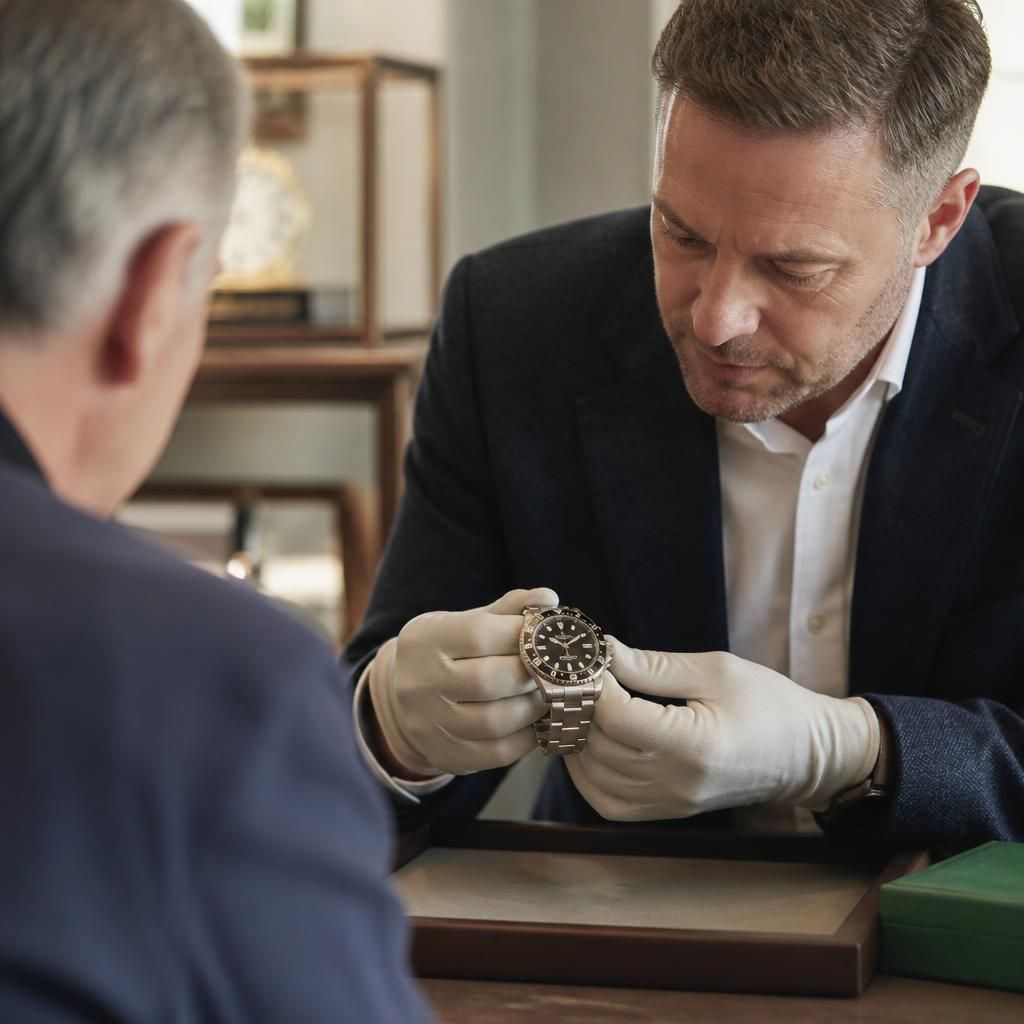
Authenticity should be verified through a physical examination of the complete watch, not by relying on its serial number, box or papers alone. A qualified specialist should compare the reference with the case, dial, hands, bezel, bracelet and movement, checking that the parts are genuine and appropriate for that configuration.
This inspection can also identify aftermarket components, incorrect replacement parts, over-polishing and mechanical issues that photographs may conceal. Before purchase, ask for the findings in writing and ensure any modifications, servicing needs or limitations on water resistance are reflected in the description and price.