
How important is verifying the authenticity of a used Rolex Sea-Dweller or Deepsea?
Verifying the authenticity of a used Rolex Sea-Dweller or Deepsea is essential, as counterfeit, stolen or heavily modified watches can be difficult to identify from appearance alone. A reputable expert should check the case, serial details, movement, dial, bracelet and provenance before purchase, helping protect both your money and the watch’s long-term value.
Verifying the authenticity of a used Rolex Sea-Dweller or Deepsea is essential before purchase. These watches are frequently counterfeited, altered with non-original parts or presented with misleading documentation, and appearance alone is not a reliable test. A proper assessment should examine the watch itself, its movement, its identifying details, its service history and its provenance.
Authenticity matters for more than the prestige of owning a genuine Rolex. It affects the watch’s mechanical performance, water resistance, serviceability, insurance position and resale value. A counterfeit may contain an unsuitable or inferior movement, while a genuine watch that has been heavily modified may no longer meet the specifications associated with the original model.
What should be checked?
- Reference and model details: The reference number should correspond with the Sea-Dweller or Deepsea configuration, including the case size, bezel, dial, bracelet and movement fitted for that production period. The dial printing, date display where applicable and depth rating should be consistent with the model.
- Serial and identifying markings: Serial details should be present in the correct form and location for the watch’s age. Their engraving quality, alignment and relationship to the reference information should be assessed carefully. Altered, poorly executed or inconsistent markings are significant warning signs.
- The movement: The movement is one of the most important authentication points. An expert can check whether the calibre, finishing, construction and markings are appropriate for the reference. Photographs of the exterior cannot confirm that the correct movement is inside the case.
- Case and bezel: The case profile, crown guards, screw-down crown, helium escape valve and Cerachrom bezel, where fitted, should match the model. Excessive polishing can remove the original shape, while incorrect machining or uneven finishing may indicate replacement or counterfeit components.
- Dial and hands: The fonts, luminous material, markers, printing, hand shapes and positioning should be consistent with the relevant generation. Relumed dials, replacement hands and refinished surfaces may not make a watch counterfeit, but they should be disclosed because they can affect originality and value.
- Bracelet and clasp: End links, clasp markings, construction and fit should be checked against the reference. A genuine head fitted to an incorrect or later bracelet may still be authentic, but the alteration should be reflected in the description and price.
- Deepsea-specific construction: The Deepsea’s high-pressure design includes specialised case architecture and the Ringlock System. These components require particular scrutiny because incorrect replacement parts or poor servicing can affect the watch’s ability to withstand pressure.
Box and papers are useful but not conclusive. A warranty card, presentation box, instruction booklet and service paperwork can support a watch’s history, particularly when the details correspond with the watch and the documents appear consistent with its production period. However, paperwork can be lost, replaced or paired with another watch. It should never be treated as proof of authenticity without examining the watch itself.
Provenance is also important. A clear purchase history, previous service record and evidence of ownership can reduce uncertainty. Where available, the seller should be able to explain when the watch was acquired, whether it has been serviced, which parts have been replaced and whether it has been exposed to significant impact, moisture or magnetism. A lack of history does not automatically mean a watch is false, but it increases the importance of an independent inspection.
Authentic does not always mean entirely original. Used Rolex watches can have legitimate replacement components following servicing or repair. A dial, bezel insert, crystal, bracelet, clasp or movement part may have been changed during the watch’s life. The key questions are whether the parts are genuine, whether they are correct for the model, whether the work was carried out competently and whether the changes have been disclosed. A so-called “ Frankenwatch” may combine genuine parts from different watches in a configuration that was never produced by Rolex, making a simple genuine-versus-fake assessment inadequate.
There are several practical warning signs. Be cautious if the price is materially below the level expected for the reference and condition, if the seller discourages examination, if serial details are obscured, or if the watch is described as “exactly like” a Rolex without clear confirmation of its origin. Other concerns include poor dial printing, incorrect luminous performance, a loose or unsuitable bracelet, an inappropriate movement sound or operation, unexplained gaps in the history and pressure-resistance claims that have not been tested.
Water resistance deserves particular attention with these models. A watch may be genuine but no longer suitable for diving after ageing seals, damage or incorrect servicing. Water resistance should be confirmed through an appropriate pressure test by a suitably equipped professional; it should not be inferred from the model’s original specification. This is especially important for the Sea-Dweller and Deepsea because their specialised cases are designed for demanding underwater use.
Before committing to a purchase, ask for a detailed description of the reference, serial information, condition, service history and any replaced components. Have the watch inspected by an experienced watch specialist who can open the case safely, examine the movement and assess the case and bracelet. If the watch is being bought privately or from a less established source, agree in writing that the sale is subject to authentication and ensure there is a clear return arrangement if it fails inspection.
For an existing customer considering a used Rolex Sea-Dweller or Deepsea, independent verification is the most reliable way to protect the purchase. It can identify a counterfeit, reveal undisclosed modifications, establish whether the model is correctly configured and highlight servicing or pressure-testing requirements. The result is a more accurate understanding of what is being bought and whether the asking price reflects the watch’s genuine condition and originality.
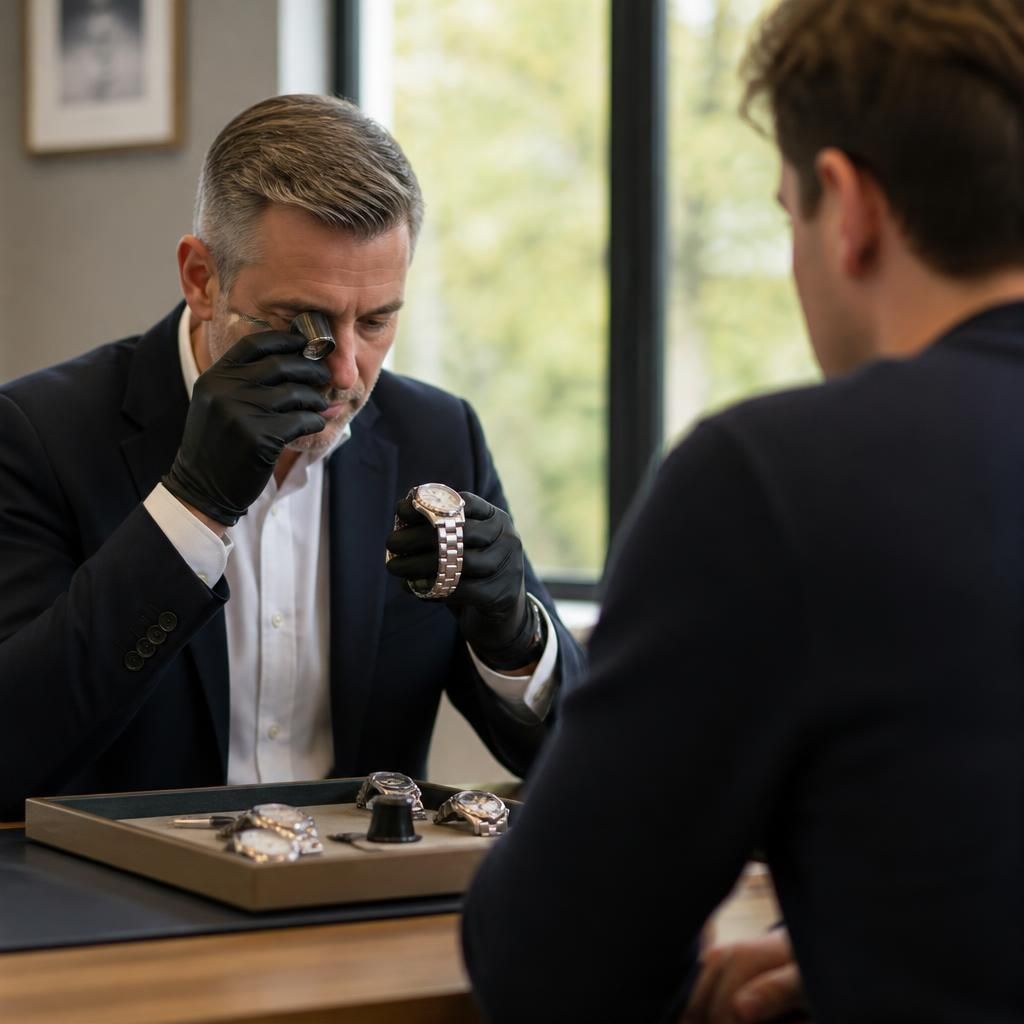
Authenticating a used Rolex Sea-Dweller or Deepsea requires examination of the watch itself, not just its box and papers. An experienced specialist should compare the reference and serial details, inspect the case, dial, bracelet and clasp, and examine the movement to confirm that the components are appropriate for the model and production period.
Original paperwork can support the watch’s history, but it may be lost, replaced or paired with another watch. This is particularly important with the Deepsea, where the specialised case construction and Ringlock System also need careful assessment. Verification can reveal counterfeit parts, undisclosed modifications and servicing issues that photographs or documents alone cannot confirm.
Discuss authenticating your used Rolex Sea-Dweller or Deepsea
Discuss your used Rolex Sea-Dweller or Deepsea with our experienced team before completing your purchase. We can help assess its authenticity, condition, originality and supporting documentation, with further checks recommended where necessary.